domingo, 19 de enero de 2014

Always in Indian. Only

Welcome back to the rez everyone! In this new entry we'll be talking about the a fore mentioned themes in the play through which Highway portraits the new native woman.
The first thing we will be dealing with is sex and sexual relationships. If you have read the play, you will have noticed that it is very much physical, in violence or when Philomena shouts at all the other women to “let [her] shit in peace.” (43) (quick note before I forget, the edition of the play I'm using for the quotes is as follows: Highway, Tomson. The Rez Sisters, Fifth House, Markham, On :1988 . All the quotes come from this text) . So sex wasn't going to be an exception.
Sex as well as sexual relationships are portrayed in different ways in different characters.

The first character to be explored will be Marie-Adele. This poor woman, mother of 14, “Imagine. And all from one father.” (21), is dying from ovarian cancer. Yes, as bad as it sounds. She is shown as very devoted woman, both to her children and her husband, to whom she is very close. Her illnes is driving them apart, and Marie-Adele feels emotionally and sexually frustrated, as she reveals in her conversation with Pelajia,

“Marie-Adele: I could be really mad, just raging mad just wanna tear his eyes out with my nails when he walks in the door and my whole body just goes “k-k-k-k” …. he doesn't talk, when something goes wrong with him, he doesn't talk, shuts me out, just disappears. Last night didn't come home. Again, it happened. I couldn't sleep. You feel so ugly. He walks in this morning. Wanted to be alone, he said. The curve of his back, his breath on my neck, “Adele, ki-sa-gee-ee-tin oo-ma,” making love, always in Indian, only. When we still could. I can't even have him inside me anymore. It's still growing there. The cancer. Pelajia, een-pay- seek-see-yan.” (96)

A quick note before we follow, the language they are speaking, apart from English of course, is Cree, and, as I guess you are not very fluent, here are the translations:
“Adele, ki-sa-gee-ee-tin oo-ma” : “Adele, I love you”
“Pelajia, een-pay-seek-see-yan” : “Pelajia, I'm scared to death”
Back to the text, Marie-Adele is complaining about the lose of intimacy with Eugene (her husband) not only sexually, but emotionally, he has closed himself up and refuses to communicate. Still sex is the physical experience of the emotional link between them, and Marie-Adele can't help it but feel frustrated when they are unable to be physically together.

Adele is not the only one dealing with problems regarding sex, Philomena as well has some wounds to heal. In the van, on their trip to Toronto, Philomena tells the story of her baby:

“Philomena: Toronto. Had a good job in Toronto. Yeah. Had to give it all up. Yeah. Cuz mama got sick. Philomena Margaret Moosetail. Real live secretary in the garment district. He'd come in and see my boss. Nice man, I thought. That big, red, fish-tail Caddy. Down Queen Street. He liked me. Treated me like a queen. Loved me. Or I thought he did. I don't know. Got pregnant anyway. Blond, blue-eyed, six foot two. And the way he smelled.
God! His wife walks in on us.

Long silence

He left with her.

Long silence

I don't even know to this day if it was a boy or a girl. I'm getting old. That child would be … 28 … 28 years old. September 8. you know what I'm gonna do with that money if I win? I'm gonna find a lawyer. Maybe I can find that child. Maybe I wouldn't even have to let him … her... know who I am. I just … want to see … who … “ (81)

Philomena was forced to abandon the baby she had with her white lover. A man who, even though, seemed to love her, decided to stay with his wife. This mixes not only sexual relationships but also racial ones. Neither the lover nor Philomena would be allowed to have such relation, still the one who is forces to give up everything, as she herself says, is Philomena. Here she has to fight with being a native and a native woman.

Annie has to face racial issues in her relationship with the Jewish singer of the band Fritz the Katz. While she is trying to talk about it with Emily, she just keeps making fun of everything until they happen to be comparing white and native men,

“Emily: How about Fritz? What's his look like?
Annie: After an awkward pause.
He's Jewish you know.
(...)
Annie: Fritz buys me jeans and things. I'm gonna be one of them Jewish princesses.
Emily: What's wrong with being an Indian princess?
Annie: Aw, these white guys. They're nicer to their women. Not like Indian guys. Screw you, drink all your money, and leave you flat on your ass.
Emily: Yeah, right. Apple Indian Annie. Red on the outside. White on the inside.
Annie: Emily!” (85-86)

Poor Annie feels outraged about Emily's comment of her being white on the inside, still she makes a clear distinction between “Indian guys” and “white guys”. And she doesn't even know how to say that Fritz is not Native like them.
By the end of the book, these two seem to be catching up right where the left it,
“Annie: I'm singing back-up for Fritz weekends. 25 bucks a gig. That's something, eh?
Emily: Katz's whore...
(…)
Annie: I love him, Emily.” (105-106)

These women's sexual encounters are determined by their situation as natives, as Marie-Adele says “Making love, always in Indian. Only.”, Philomena had a white lover, but while she was in the city and wasn't so constricted by the rules regarding them in the reservation, and so happens to Annie, whose daughter lives with Raymond (“ Not Raymond. But Raymond. Like in Bon Bon. He 's French.” Annie Cook's French lessons everyone!), but not in the reserve either.


Well guys, what do you think about this? Do you think they are determined in any case? Let me know in the comments!

But... Women are women, right?

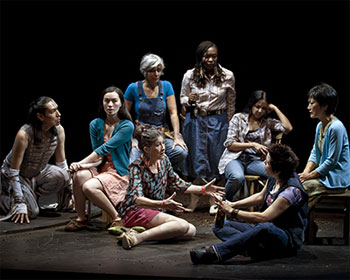
 In this play, the reader can enjoy the pilgrimage of seven women from their reserve, Wasaychigan Hill Indian Reserve, in Manitoulin Island, Ontario, to the biggest bingo in the world in Toronto.
These seven women are the protagonists of the story. Yes, seven protagonists, all equal in their importance. And you, dear eurocentric reader, might be saying, what!? Well, it is one the characteristics of Native literature, and we'll see what it means in a second.
The characters are Pelajia Patchnose, Philomena Moosetail, Marie-Adele Starblanket, Annie Cook, Emily Dictionary, Veronique St. Pierre and the lovely Zhaboonigan Peterson.
Again, all women, and this is the point we will be making here. These women exemplify the different themes in the play, adding as well, a very interesting gender perspective to the study of The Rez Sisters.
In the previous entry, we have saying that the play depicts many aspects of Native culture and society, some of the aspects are the sense of community, sexism, womanhood, consumerism, the consequences of the clash with white culture, etc... all of them have to do in one way or another with women, and therefore, ,with gender.
What Highway was proudest about was about the gender perspective of his work because “ it raised public consciousness of an specific segment of the women's community- Indian women and older women at that” (Tomson Highway, from Jennifer Preston, “Weesagediak Begins to Dance: Native Earth Performing Arts Inc.”, The Drama Review 9:1/2 (1987))

Women here have to deal with their situation as women in the reserve as well as in comparison to the dominant white culture that surrounds and affects all of them.
Highway himself was a product of that cultural collision or in more political terms exchange, so this mixture is very present in his text.
Indeed he will be showing us a new image of the Native woman through the several aspects that we'll be discussing here as the themes of The Rez Sisters.
Since we are taking a feminist perspective on a post-colonial text, it is important to talk about what post-colonial feminism is.
Some of you might be thinking, well, feminism is feminism, right? Well, yes and no. According to critic Chandra Talpade Mohanty, in her article “Under Western Eyes, Feminist scholarship and colonial discourse”,

“the critical assumption that all of us of the same gender, across classes and cultures, are somehow socially constituted as a homogeneous group identified prior to the process of analysis. This is an assumption which characterizes much feminist discourse. (…) What blinds women together is a sociological notion of the 'sameness' of their oppression.” (244)

It is true then, that women as a group are oppressed, but since feminist has been mainly constructed by western women, and therefore, they result in the implicit assumption of “the West” as the primary referent in theory and praxis.
The problem appears with the realization of the West being the dominant culture and unconsciously ignoring the situation of women in other cultures and situations, which falls as simple and unnecessarily homogenizing. Mohanty also says that the 'Third World Woman' is” an image which appears arbitrarily constructed, but nevertheless carries with it the authorizing signature of Western humanist discourse.” (242)
Do you remember when I said that the Natives were writing their own story?, The same point can be made referring to Native women, whose situation must be considered as different and studies as such. Because, as Mohanty states, “Sisterhood cannot be assumed on the basis of gender; it must be formed in concrete, historical and political practice and analysis.” (244)


This has been a short introduction about the perspective with which these type of texts should be approached, and also the approach I'll be taking to the comment of The Rez Sisters.

What's all this about?

Hello everyone! I knew you wouldn't be able to wait any longer for a new entry, so here I am.
We know that this blog is about the play The Rez Sisters, we have dealt with history, with the author and with some more theater. So now it's time to get work done, let's start with the sisters!
And that's how you start writing your own story

I am not going to summarize the play, because that would take too long, and I can almost assume that most of you have read it already (if not, what exactly are you waiting for?). I will just say this: Seven women, the biggest bingo in the world, one van and plenty of hidden stories. What could possibly go wrong?
Now I'll be briefly talking about the depiction of Native reality portrayed in the play. Somethings will be just mentioned and discussed in greater detail later on.
In the play there is an accurate depiction of the native reality (remember I told you about native people telling their own stories? There it goes), such as alcoholism and materialism. But, above all, there is an overwhelming sense of being left behind, for example, Pelajia's son works in Toronto and Annie's daughter “lives with this white guy in Sadbury”.
The younger generations are gone, and they are stucked in the reservation, in the middle of nowhere. As Pelajia (my dear and brilliant Pelajia) puts it, “Everyone here's crazy. No jobs. Nothing to do but drink and screw each other's wives and husbands and forget about our Nanabush” (6)
All this has to do with the post-colonial nature of the society that the play is talking about. In general terms, we could say that the play represents the collision of the cultural and spiritual values of natives and non-natives.
For example, the reserve functions as a representation of all the Native communities in Canada, indeed, its name, “Wasaychigan” means “window” in Ojibway. Outside the reserve, we can see an all powerful white economy, while inside it shows signs of self-destruction and self-preservation.
This play explores the problems that are destroying native society. White and native culture collide, for their differences are not accommodated.
A good example of this problem, are the goals the women want to accomplish by winning the bingo's jackpot. Pelajia wants paved roads, Philomela wants a need bathroom, Annie a record-player and Veronique a new stove.
While some might see these needs as mere materialistic desires, they are, indeed needs created by white society. On the other hand, these goals are unconscious ways to survive to the negative consequences derived from the collision with the white world: Emily was daily beaten by an alcoholic husband (here alcohol is an escape), Philomena was abandoned by a white lover and forced to leave her baby and finally Zhaboonigan, who was raped by some white boys.
This rape wants to express the violence experienced by the native community on the hands of white culture (and it also is a recurrent topic in Highway's work). Actually it is based on the rape and murder of Helen Betty Osborne, a native Cree girl, by a bunch of white boys. The most hideous thing about this crime is not just the crime itself, but the reaction of the people directly and indirectly involved in it. Even though everybody knew about it , it took ten years to get it to trial and only one of the four guys involved went to jail, and just with a light sentence. If you want to know more, nowadays there is a big movement in Canada for the crimes committed against native women.
Another example of this collision can be seen in the suicide of Rose (Rosabella Baez), driven to self-destruction by the destructive force of a dominant culture or, to put it in her own words, of “how fucking hard it is to be an Indian in this country”.(97)

Now, don't get all sad, because despite this tragic, native philosophy of rebirth and hope is also present throughout the play.


So, what do you think about the cultural collision? Do you think it is accurately represented? Do you think that the consequences Highway shows are realistic?

jueves, 16 de enero de 2014

And the rez was born

Here I am, ready with some brand new information for you! We have been talking about theatre and how great “The Rez sisters” is, but I still haven't talked about the amazing man who wrote it.
The author of the play is Tomson Highway, a cool name for a very cool person.

Tomson Highway


Born in 1951, this full blood Cree is a registered member of the Barren Lands First Nation, the village for which is called Brochet, located in northern Manitoba, where it meets Saskatchewan and what is now called Nunavut.
Since his family was a nomadic caribou hunters, he didn't grow up in the reserve. When it was time to go to school, according to the policies regarding natives at that time, he was sent to Guy Hill Indian Residential School, from age 6 to 15, where he was abused by the priests who ran the school ( I won't go into further detail about it, but it is a very controversial topic until now, since many First Nations have issued Canada's government for the treatment these poor kids received. Anyways, if you are interested in it let me know in the comments).
After leaving (or surviving) the school, he got a double bachelor with honors in Music and English (1975- 1976). In case you hadn't noticed by now, he is an artist from head to toe, something he says he has inherited, because his mother was an artist of her own, being a very skillful person in bead-worker and quilt maker.
After graduating, he worked for seven years in the field of native social work, helping children, parents, inmates in prisons, women, two-spirits and other native social workers and activists.
Finally, in 1986, he published his 6th play, The Rez Sisters. This was the first one in a planned seven-play cycle all based on the same set of characters, themes and settings. So far the play has been followed by two others: Dry lips oughta move to Kapuskasing and Rose.
Lucky Nanabush

In 1998, he published his first novel “Kiss of the fur queen”, in memory of his brother, native dancer and choreographer René Highway, who died from AIDS.
Highway has received many awards, such as the National Aboriginal Achievement Award (2001) or the Order of Canada (1994), but as his official web page (http://www.tomsonhighway.com ) says, he has also earned “others too embarrassingly numerous to list. In fact, at one point in his life, his trophy case collapsed from the terrible weight and killed three people.”
He has also been a writer-in-residence at several Canadian universities and has also taught Aboriginal Mythology at the University of Toronto.
And, just in case this wasn't enough, he holds more honorary doctorates than you could count.

That's all folks! At least by now. But before I go, let me show you an interview with Highway. I hope you enjoy it!


Life before the rez

So far we have talked very briefly about Canadian history and its people, so now we are going to move on to their writing.
This blog will be focusing on the most important play ever written by and probably about Native people in Canada, The Rez Sisters. This amazing play (something you either already know or are about to know) was written by Tomson Highway in 1986 and started a sort of revolution. But anyways, before we get to that, let's see if there was something before it... Yes! There is!
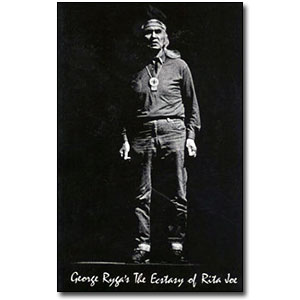
In 1967, the non-native (form Ukrainian origin indeed, so not quite close to the natives) author George Ryga premiered his play The Ecstasy of Rita Joe, what native author Drew Hayden Taylor (the blue eyed Ojibway or the pink man, as he calls himself, which I highly recommend, but don't be lazy, read the [ab]original one!) describes as “the occasional flare-up of native performance in the theatrical community”.
This was the first play to portrait the tragic of aboriginal people, depicting the martyrdom of a native girl in the streets of Vancouver.
So far so good, right? Well, now comes the big BUT. The problem with this play is that it was written for white middle-class audiences, and reflected the eurocentric, patriarchal paradigm which, at the same time, reflected the assimilation policies of the time.
The play is a didactic indictment of a white society and state that have deprived the native communities of their traditions and then, have irresponsibly failed to provide them with new identities for the city.
The character are stereotypes, being the natives either part of the noble-savage or grateful kids. Generally speaking, there was this romanticized version of the natives, who would be prostitutes or drunks in an attempt to portrait the universal tragedy of hopelessness.
Truth be told, in general terms the play is well intentioned but inadequate for, as Ryga himself puts it “it is not so much indigenous, but universal.”
So, how would you feel about the new kid in school who stole your lunch, telling your own story? Not funny I guess.
Well, that is what Tomson Highway thought, and what led him to write his most famous play. The Rez Sisters meant a turning point when it first appeared in 1986; for the first time, a native writer wrote about native people. They were telling their own story.
Thanks to the big success of the play and those that followed, aboriginal theater became visible with other authors like Ojibway Drew Hayden Taylor (already mentioned, I know), Algonquin Yvette Nolan and also a bunch of aboriginal theater companies.

Are you impressed or what? If the answer is no (which I don't understand), just wait and see what's coming next!


miércoles, 15 de enero de 2014

Those British and French fighting again...

Since Canada is not a visible as, for example the USA, we sometimes tend to forget that it has a history too, and, surprise surprise, it is also a post-colonial one.
The first European contacts to be reported are previous to the Spanish discovery of America. The first attempts to colonize what is now called Canada were made by the Norse people, and they actually wrote about it, The Icelandic Sagas, if you liked Beowulf, you just can't go wrong with this one. This all was just an attempt, the poor Norsemen couldn't stand the weather and the harassment of the native people.
Later on and thanks to the Treaty of Tordesillas, Portugal obtained some right over the Canadian land, but it didn't last because around the second half of the 16th century they decided to focus on Brazil.
But the land didn't stay 'inhabited' long, in 1534, the first French settlers arrived and in 1608 geographer Samuel de Champlain founded what today is Quebec city, first permanent settlement of New France.
Now, English and French can't be apart, and in 1583, the English claimed St. Jonh's,
Newfoundland as the first North American colony. Then in 1622 the first group of Scotish people was sent to Canada to start a new settlement, but this didn't succeed, and Nova Scotia settlements were not permanent after the Anglo-French War (1627 – 1629). Unfortunately for the English in 1631 these territories went back to French control. During this period the inhabitants of New France were rather busy trying to create an empire.
By 1700, the French were well established, but... hold on, the empire strikes back. Well, not the empire, the English, almost the same. French settlers stopped coming to Canada, resulting in their outnumber by English and Scottish.
All these tensions ended with the French and Indian Wars, and later on with some wars with the English. Not surprising, its genetics, if they have a chance to start a war between them, they will.
In 1710 the British conquered Acadia and after the Treaty of Utrech, France had to cede what they had gotten in the Battle of Hudson's Bay. But don't think they just stood there, France then founded the powerful Fortress of Louisbourg on Cape Breton Island.
But the drama did not stop there, even after the treaty there was war and in 1755 the British ordered the expulsion of the Acadians to other French colonies (still, a big number of them went to Louisiana where they created the Cajun culture, remember The Awakening?).
By 1760 both Quebec and Montreal were under British control. After the Seven Years War and the Treaty of Paris (1763) ceded almost all its territory in North America and took instead the Caribbean colony of Guadeloupe. Britain took over, but protected the religious, social and political rights as well as the culture of the French inhabitants. Something very clever if you ask me, I can totally understand that they wanted to preserve “poutine”, such a delicious thing.

Slightly off-topic, but here's a poutine picture. Typical food from Montreal,.


I think this is quite enough for an introduction, but now you get an idea of where the Canadian identity (or rather its European origins) comes from.
Now, you might have noticed that we have been talking about Canada as an empty land (definition that later on would be given to Australia), but that was not the case, there were plenty of people, people who didn't care about “poutine” at all.

Canada was a vastly populated land, with people going from the Artic to the actual US border (another interesting topic, since some of these nations are divided by a demarcation that they don't recognize, but we'll leave for another time maybe).
Nowadays the word aborigine is the one used since 1980, and according to the Constitution there are all of these nations: Abenaki, Akaitcho, Algonquin, Anishinaabe, Athapaskan, Atikamekwa, Blackfoot, Cayuse, Chippewa, Colville, Cowichan, Cree, Deh cho, Ditidaht, Dogrib, Dunneza, Gitksan, Gwich’in, Haida, Haisla, Heitsuk, Hurón-wendat, Iroquois (Onondaga, Cayuga, Seneca, Oneida, Tuscarona and Mohawk) , Kaska, Katzie, Ktunaxa, Kutchin, Kwantlen, Kwakiutl, Lubicon cree, Malecita, Micmac, Montagnais, Musqueam, Naskapi, Na-cho nyak dun, Nakoda, Nicola, Nisga’a, Nuxálk, Odawa, Ojibway-chippewa, Okanagan, Oneida, Palus, Potawatomi, Shatu, Sinixt, St’at’imc, Tahltan, Tanana, Tasltine, Tlingit, Tsimshian, Tsuu t’ina, Walastakwewinowok, Wasco, Wishram, Yakima and Yupik. Plus Métis and Inuits.
And all of us thinking it was just those British and French fighting again....

Here it is a map of the native lands and tribes at the time of the European contacts taken from http://www.canadahistoryproject.ca/1500/ a very useful page if you want to know more about Canadian history.


Regarding native people, and I know it is stating the obvious, they had their own languages and cultures, as well as a literary tradition. This tradition was oral, but thanks to works such as The Rez Sisters or authors like Jeannette Armstrong (who actually created the term “orature” as a reference to the new native literary tradition, that is, a mixture of oral and written tradition) among many others, they have survived until now, so we can enjoy them.
All of these cultural references and traditions, in addition to language will be found in the works of Native authors.


Ok everybody, I think this is it for today! Do you think natives and native culture are survivors?  

martes, 14 de enero de 2014

Welcome!

Canada is on vogue, and for better reasons than Justin Bieber or “How I met your mother”. This year, Alice Munro has become the first Canadian author to win the Nobel Prize for Literature, a remarkable success, that nevertheless, should make us wonder, that's it? One could easily fall into the mistake of thinking that there is no more Canadian literature beyond Alice Munro or, luckily enough, Margaret Atwood.
What do you, my dear readers, think? I am sure you all are clever enough to know that that's not true, but if you want to know more, stay tuned for updates to come!